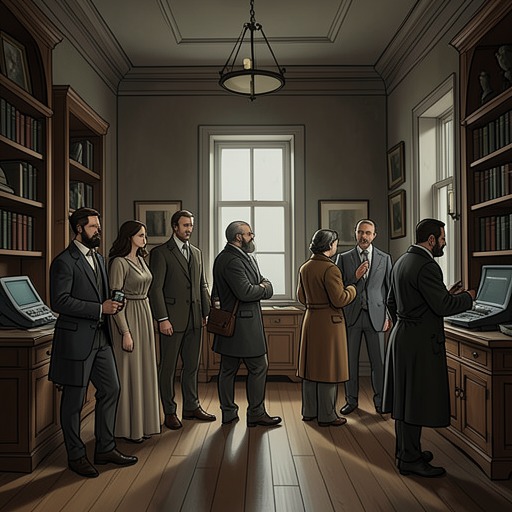
Dechambre
In Search of Lost TimeDechambre, once Madame Verdurin’s favourite pianist, is recalled after his death as a musician who had earned a Paris reputation before the salon’s influence took hold. The conversation about him turns from artistic memory to social convenience: his hosts debate his talent, but the salon’s routine makes the dead easy to erase.
Identity and Reputation
Brichot remembers Dechambre as already established in Paris when Elstir and Swann attended Madame Verdurin’s salon. He stresses that the pianist achieved recognition without first receiving the public acclaim that Brichot mockingly calls the Gospel according to St Barnum. In another recollection, Brichot says Dechambre played Vinteuil’s sonata for Swann, at a time when Swann was estranged from the aristocracy and had not yet become Odette’s socially assimilated prince consort.
Dechambre’s place in the salon was not merely professional. He had been Madame Verdurin’s favourite pianist, and Brichot treats his death as the loss of a considerable talent. These memories preserve a career extending back to the earlier days of the circle, even as the people around him dispute what that career amounted to.
Death and the Salon’s Memory
Brichot announces that Dechambre has died and calls the news dreadful. Cottard replies that Dechambre was still quite young, though he speculates that a liver complaint may have been troubling him for some time; this is Cottard’s conjecture, not a confirmed account of the illness. Brichot corrects the impression of youth by pointing to Dechambre’s long professional history.
The announcement prompts Brichot to wonder whether Madame Verdurin has been told. The narration describes a salon whose members, like those of society more broadly, cease to occupy its attention once death prevents them from returning to Wednesday or Saturday gatherings or dropping in to dinner. In that social arithmetic, death makes a person seem never to have existed. M. Verdurin has therefore represented silence about the dead as necessary for his wife’s health, allowing the dinners to continue without the interruption of mourning. The Princess confirms that Madame Verdurin learned the news that morning, since it could no longer be kept from her.
Conflicting Assessments
M. Verdurin objects when Brichot continues to mourn Dechambre. He concedes that the pianist played well but denies that death should turn him into a genius. In his account, Dechambre’s reputation depended on being in the right surroundings: transplanted from the salon, he ceased to exist as an artist. M. Verdurin says his wife had been infatuated with him and had made his reputation, presenting the salon as the force that shaped the pianist’s standing.
He also recalls Dechambre’s declining physical command: during the last year, he says, Dechambre had to practise scales before a concert to recover, only briefly, the suppleness of his wrists. This concrete detail gives M. Verdurin’s dismissal a practical basis, but his comparison is also pointedly self-serving. He declares that Dechambre died at the right moment for his reputation, then turns to the dinner and the grilled lobsters expected from Pampille’s recipe. The passage sets the language of artistic loss against the host’s impatience with delay and hunger.
Narrative Significance
Dechambre never appears in person in this episode; readers encounter him through recollections and judgments voiced by those who remain. Brichot’s account links him to an earlier artistic and social history, while M. Verdurin recasts that history as evidence of the salon’s power to manufacture reputations. Neither account restores Dechambre to the present. His death instead makes visible the circle’s governing contradiction: it can claim to have made a musician memorable while treating the dead as socially nonexistent once they can no longer participate.
The contrast also gives the discussion its sharpest edge. Brichot mourns a talent and trusts M. Verdurin’s explanation of the need for silence; M. Verdurin converts that supposed delicacy into a reason not to speak of the deceased, and then minimizes the very artist whose reputation he says his wife created. Dechambre’s afterlife in the conversation is thus controlled by the living salon: remembered as a serious musician, reduced to a product of his surroundings, and finally displaced by the evening’s arrangements.